Sexualities, Gender, and Relationships
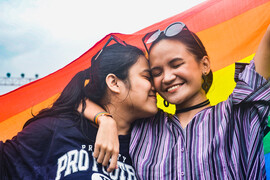

Our attractions and identities are powerful and intimate parts of who we are. More and more, people understand that gender identity and sexual orientation are aspects of life that don’t fit neatly into boxes. This subject area addresses these separate yet sometimes intertwined topics that affect our relationships with ourselves, one another, and the world.
Sexuality is a state of being, a way of experiencing and giving. When we are aroused by sexual stimulation, from whatever source—fantasies, a certain image or scent, an environment, a partner’s word or touch—it’s common to go through a series of physical, mental, and emotional changes. These changes are often referred to as “sexual response,” though it’s probably more accurate to refer to sexual responses, plural. Although there are some commonalities in how women experience arousal, there are also wide variations. Our responses vary not only from person to person but also at different times in our lives and from one sexual experience to the next. There is no one right pattern of sexual response. Learning about our own sexual response cycle can be empowering.
Sexuality has the potential to be a powerful and positive force that deepens intimate connections. Because of stigma, misogyny, and trauma, it can also be a source of great pain. For many of us, sexual pleasure can be compromised by physical or emotional challenges. The difficulties can be even harder to bear when medical providers find no underlying cause or do not offer suggestions for relief. Variations of desire and difficulties with arousal can make insertive sex difficult if not impossible, and the sexual challenges sometimes experienced by women and gender-expansive people with specific chronic illnesses and disabilities. Medications and hormones influence physical responses to sex and sexual pleasure. Stories from women and gender-expansive people illuminate what has and what hasn’t worked for those of us who wish sex were something that we could enjoy more fully and without hesitation.
We promote the model of “yes means yes,” showing how enthusiastic consent can allow for the expression of desire, intimacy, vulnerability, and power. We look at how sexuality develops through individual desire as well as social and cultural influences. It includes the voices of many women who have shared their diverse experiences around sex and sexuality. Sexuality that is vanilla or kinky, within monogamous or polyamorous relationships, as well as singlehood and celibacy are included.
Meanwhile, the two simple categories of woman and man are not enough to contain how we see ourselves and how others perceive us in terms of gender. Moving beyond the concept of two fixed gender identities is a new challenge for some of us, and a very personal story for others. Some of us grapple with and analyze our gender; others take it for granted, especially if our gender expression fits society’s conventions based on the sex we were assigned at birth.
Sexual orientation is also a spectrum. Women and gender expansive people alike can identify as straight, lesbian, bisexual, queer, or any number of other sexual orientations. Our sexualities are a key part of who we are, including when we do not have or do not want sexual feelings. Some who transition find that their sexual orientation changes during the process. Sex, gender, and sexual orientation thus interact dynamically.